It’s all in the name?

Private label or national brand: consumers are increasingly looking at the big picture

Patrick Zevenbergen
Patrick Zevenbergen
Marketing Manager

Table of Contents

  • Products

Private label or national brand: consumers are increasingly looking at the big picture

Anyone walking through a supermarket sees it immediately: the private label is no longer the modest sibling at the bottom of the shelf. Sleekly designed, widely available, and the first choice for more and more people. This raises an interesting question. If the name on the packaging carries less weight, what does the consumer actually pay attention to?

The numbers

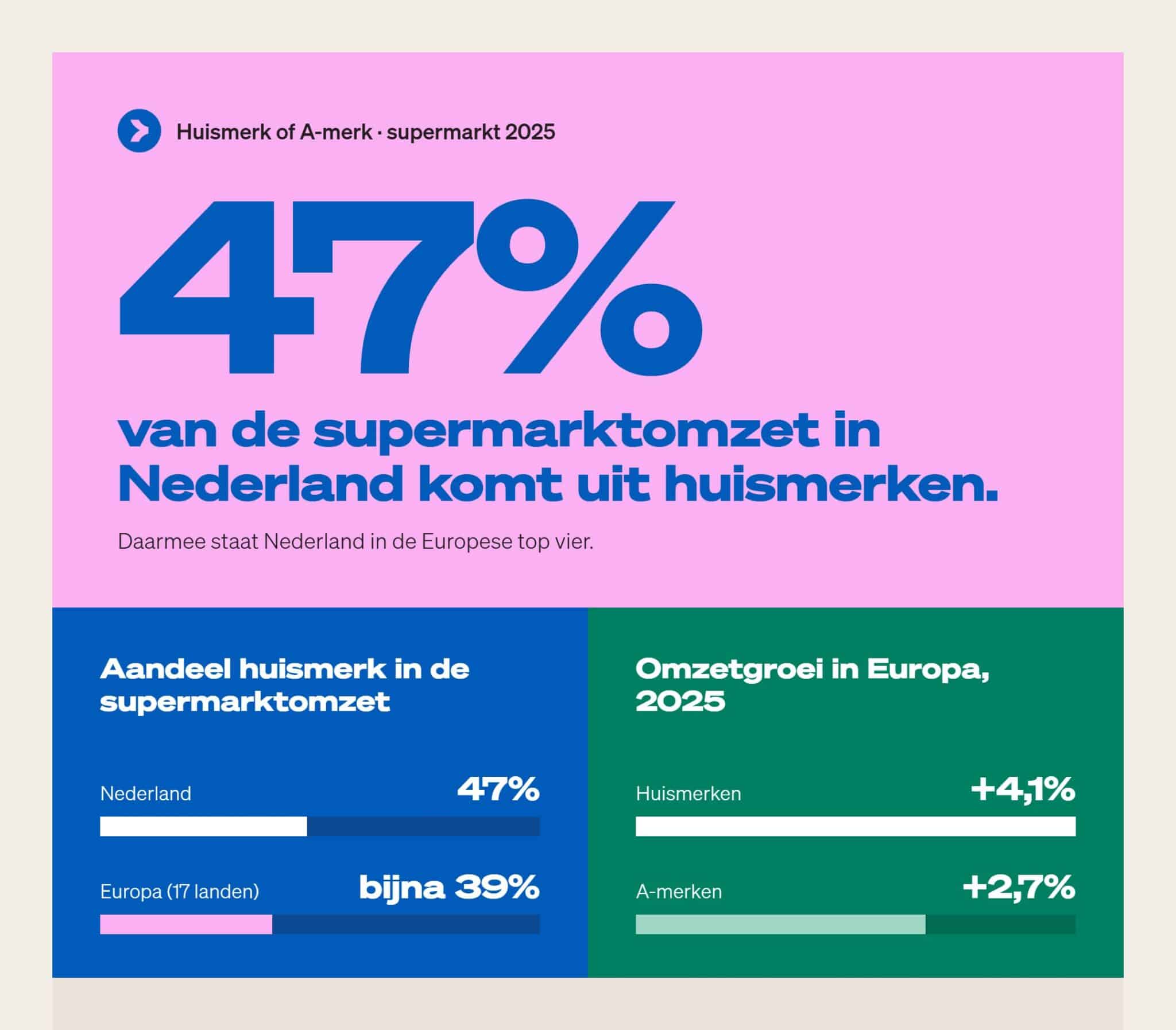
According to industry association PLMA, 47% of supermarket turnover in the Netherlands in 2025 came from private labels, ranging from food to household products. This puts the Netherlands in the European top four.

Private labels are also growing in the rest of Europe. In the 17 countries monitored by PLMA together with NielsenIQ, nearly 39% of supermarket turnover in 2025 came from private labels. Private label turnover grew by 4.1%, while national brands grew by 2.7%.
private label, national brand

Consumers look beyond the name

Due to rising prices, consumers have become more critical of their spending. Price plays a major role, and those who switch to an alternative they like do not automatically return. Brand loyalty is no longer a given for any brand. At the same time, private labels have become highly professionalized. Supermarkets are rapidly launching new own-brand lines, from plant-based and personal care to luxury products for special occasions. The private label has evolved into a full-fledged alternative in every price range. For retailers, this professionalization is also essential: a strong private label not only builds brand loyalty but also offers better control over margins, returns, and shelf differentiation.

In the household, performance is what matters most
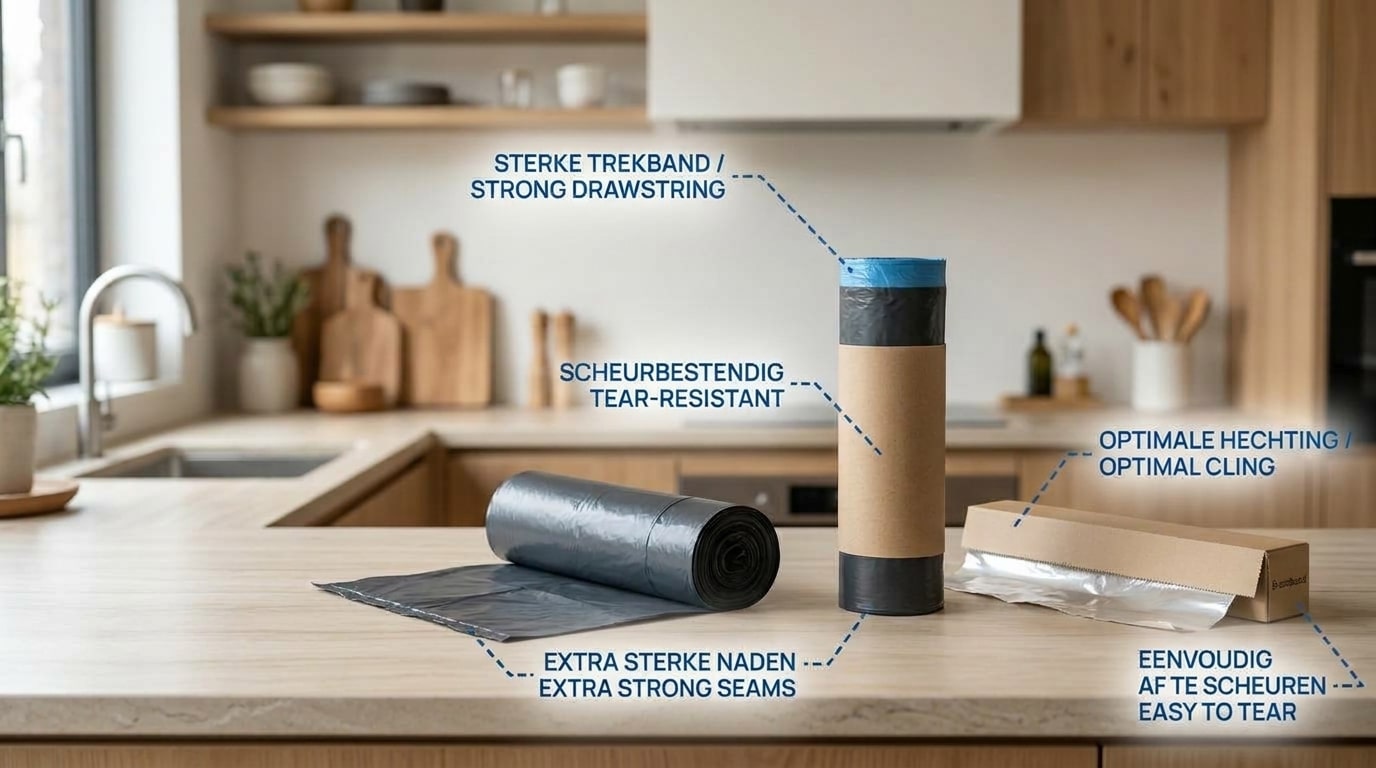
For household products, something else carries significant weight: does the product do what it promises? The private label has already secured a strong position here, but that position is not a given. A trash bag or cling film only proves itself at home, during use. Whether it features a national brand or a private label: a single disappointment outweighs any price advantage.
In the household, performance is what matters most

Behind the scenes

What the consumer experiences at home is the sum of choices we make behind the scenes. It starts with product development: the thickness of the material, the strength of the seams, a drawstring that doesn’t snap, and the level of sustainability. Details that no one sees on the shelf, but which make the difference at home. This is followed by the translation to the shelf, with recognizable sizes, a clear presentation, and an assortment ranging from entry-level to premium.

At Packit, we call that doing it the Packit way: developing every product with the same care, whether it sits on the shelf under a retailer’s name or under one of our own brands, such as Dumil. After all, the consumer at home makes no distinction between a brand and a private label. They just want it to work.

Conclusion: the name is no longer everything

A strong name remains valuable, but at most, it only opens the door. What keeps the customer coming back is the product itself. This applies to both private labels and national brands. The gain for the retailer therefore lies in the ideal combination strategy on the shelf: the national brand as a trusted crowd-puller for the conscious brand buyer, and the private label as a stable pillar for turnover and returns in every price range.

Interested in the possibilities?

Want to discuss the optimal mix of private labels and national brands for your shelves? Or looking for a private label? Get in touch by clicking the call to action button below.

Source: PLMA/NielsenIQ (2025).

Related news

Packit logo blue

Subscribe to the newsletter

This field is for validation purposes and should be left unchanged.